![Illustration representing How is Inheritance Distributed in Turkish Law [2025], showing Turkish lira, a legal document, a family of four, and scales of justice for estate distribution.](https://kaymaz.av.tr/wp-content/uploads/2025/08/how-is-inheritance-distributed-in-turkish-law-featured-2025.webp)
How is Inheritance Distributed in Turkish Law?
Inheritance in Turkey is distributed according to the Turkish Civil Code based on a strict order of legal heirs.
The distribution follows this structure:
• Children are the first heirs and inherit the largest share. If a child has died, their children (grandchildren) inherit in their place.
• The surviving spouse always inherits together with the other heirs, and their share depends on who else is inheriting.
• If there are no children, the parents of the deceased inherit. If parents are deceased, their children (siblings of the deceased) inherit.
• If no parents or siblings exist, grandparents and their descendants inherit.
• If no legal heirs exist, the inheritance passes to the Turkish State.
Real estate located in Turkey is always distributed under Turkish inheritance law, even if the deceased was a foreign national.
Understanding Turkish inheritance rules is essential for both Turkish citizens and foreigners who either inherit property or plan to leave assets in Turkey. Many foreigners who own real estate in cities like Antalya, Istanbul, or Izmir often ask how their heirs will be treated under Turkish law. The rules are especially important because Inheritance Distribution for foreigners can involve not only Turkish law but also potential cross-border legal issues.
In this article, we will explore the fundamentals of Inheritance Distribution in Turkish Law, including who qualifies as a legal heir, how property is divided, and what foreigners should know when inheriting or leaving assets in Turkey. By the end, readers will have a clear, step-by-step understanding of the inheritance process and the protections built into Turkish law.
Table of Contents
I. How is Inheritance Distributed in Turkish Law – The Legal Framework
How is Inheritance Distributed in Turkish Law – Quick Overview
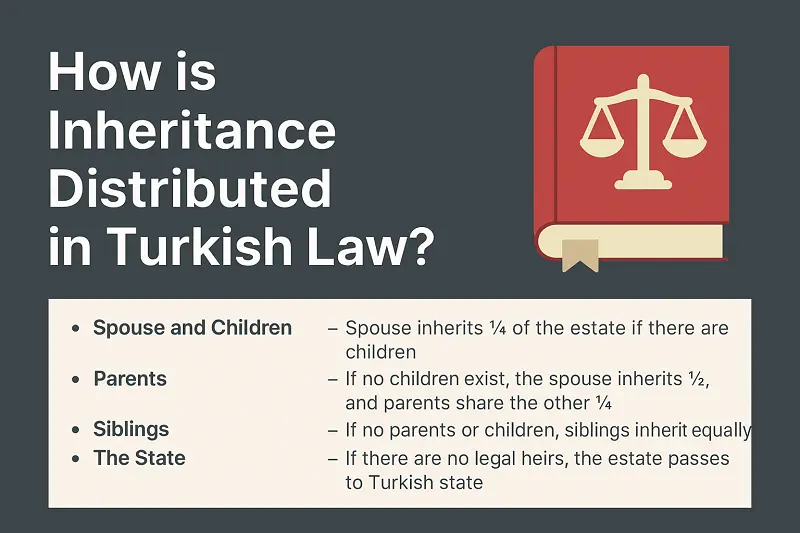
• If the deceased leaves children, the spouse receives ¼ and the children share the remaining ¾ equally.
• If there are no children, the spouse receives ½ and the parents share the other ½.
• If parents are deceased, siblings inherit.
• If no close relatives exist, grandparents and their descendants inherit.
• If no legal heirs exist, the inheritance passes to the Turkish State.
Note: Immovable property in Turkey is always governed by Turkish inheritance law, even for foreigners, ensuring clarity in Inheritance Distribution for foreigners.
When discussing How is Inheritance Distributed in Turkish Law, the foundation lies in the Turkish Civil Code. This law provides a structured and transparent framework that governs how estates are divided among heirs. For both Turkish citizens and foreigners, understanding the legal framework is crucial because it ensures predictability and fairness in inheritance distribution in Turkish law. Unlike some systems that allow complete freedom to allocate assets, Turkish law balances individual freedom with the protection of heirs’ rights, creating a system that is both rigid and equitable.
A. The Role of the Turkish Civil Code
The Turkish Civil Code is the primary legislation regulating inheritance matters. It specifies not only who qualifies as a legal heir but also how the estate should be divided in the absence of a will. For anyone asking How is Inheritance Distributed in Turkish Law, the Civil Code is the ultimate answer: it establishes the principle that heirs inherit automatically at the time of death, without the need for additional legal actions.
The Civil Code ensures that Inheritance Distribution in Turkish Law follows a clear path. The surviving spouse, children, parents, and even distant relatives are protected under specific provisions. Moreover, when it comes to Inheritance Distribution for foreigners, the Civil Code applies directly to immovable property located in Turkey. This means that even if the deceased is a foreign national, their apartment in Istanbul or villa in Antalya will be distributed according to Turkish inheritance law. This rule provides consistency and prevents conflicts between foreign and domestic legal systems.
In addition, the Civil Code outlines rules about “reserved portions” — shares of the estate that cannot be denied to children or spouses. This ensures that immediate family members are not disinherited and that distribution remains just and predictable.
B. Equality and Order of Heirs
One of the most defining features of Inheritance Distribution in Turkish Law is the clear hierarchy of heirs. The law divides heirs into groups, ensuring equality within each group and fairness between them.
- First Order Heirs: Children and their descendants. If the deceased leaves children, they inherit equally. The surviving spouse also shares in this group, receiving a specific portion.
- Second Order Heirs: If there are no children, the parents of the deceased and their descendants (such as siblings) inherit.
- Third Order Heirs and Beyond: If no parents or siblings exist, grandparents and their descendants may inherit.
- The State as Heir: In the absence of any relatives, the estate passes to the Turkish state.
This strict hierarchy ensures clarity for anyone wondering How is Inheritance Distributed in Turkish Law. Every potential heir knows their place in the order, which minimizes disputes and ensures smoother legal processes.
For foreigners, this hierarchy works in the same way when property in Turkey is involved. For instance, if a foreigner owns a summer house in Antalya and passes away without a will, their children and spouse inherit under the same rules that apply to Turkish citizens. This principle is central to Inheritance Distribution for foreigners, providing certainty across borders.
By maintaining a strict legal order and equal treatment of heirs, the Turkish Civil Code demonstrates why Inheritance Distribution in Turkish Law is considered one of the most structured systems in Europe. It guarantees protection for family members while also giving individuals some freedom through wills, a balance explored further in the following sections.
II. Who Are the Legal Heirs Under Turkish Inheritance Law?
Under Turkish inheritance law, legal heirs are determined in a fixed order. Children inherit first, followed by the surviving spouse, then parents and their descendants, and finally more distant relatives. If no heirs exist, the Turkish State becomes the heir.
For anyone asking How is Inheritance Distributed in Turkish Law, the answer begins with understanding who the legal heirs are and how they are prioritized. The Turkish Civil Code establishes a detailed structure to identify heirs and distribute the estate fairly. This structure is essential not only for Turkish citizens but also for foreigners who own property in Turkey, as Inheritance Distribution for foreigners follows the same framework when assets are located within Turkey.
Legal heirs are divided into different categories, known as “orders of heirs.” The distribution always begins with the closest relatives, and if none exist, it moves on to more distant family members. Ultimately, if no legal heirs exist, the Turkish state becomes the final beneficiary. This clear hierarchy is one of the strongest features of Inheritance Distribution in Turkish Law, providing both fairness and predictability.
A. Spouse and Children
The spouse and children form the first and most important group of heirs. If the deceased leaves children, they share the inheritance equally. The surviving spouse also inherits but with a legally defined portion. For example:
- If there are children, the spouse inherits one-quarter (¼) of the estate, while the children divide the remaining three-quarters equally.
- If there are no children, but parents of the deceased are alive, the spouse inherits one-half (½) of the estate.
This rule ensures that the spouse is always protected, and children are guaranteed their share. Many foreigners owning property in Turkey are reassured by this system, since Inheritance Distribution for foreigners follows the same approach: the Turkish Civil Code guarantees children and spouses specific rights regardless of nationality.
B. Parents, Siblings, and Extended Family
If the deceased has no children, the inheritance passes to the parents. In this situation, the spouse still participates in the distribution, typically inheriting half, while the parents share the rest equally.
If the parents are deceased, the inheritance moves to the siblings of the deceased and their descendants. This system reflects the principle of continuity: if one generation is not alive, the inheritance passes to the next.
Should there be no parents, siblings, or children, the estate goes to the grandparents and their descendants. This chain of succession highlights how Inheritance Distribution in Turkish Law ensures that the estate always finds its way to the closest living relatives.
For foreigners, this order applies without exception to property in Turkey. For instance, if a foreigner dies owning real estate in Istanbul without children or a spouse, their siblings or parents will inherit according to Turkish law. This is a critical point in Inheritance Distribution for foreigners, since Turkish law takes precedence over foreign law when immovable property is involved.
C. The State as a Last Heir
If the deceased has no legal heirs, the inheritance is transferred to the Turkish state. This only happens after all possible relatives have been considered, including distant ones like grandparents or cousins. While this situation is rare, it provides a safeguard that prevents assets from remaining ownerless.
This rule also applies in cases involving foreigners. If a foreigner dies in Turkey owning immovable property and has no recognized heirs under the Turkish system, the estate is absorbed by the state. This illustrates how comprehensive Inheritance Distribution in Turkish Law is, leaving no legal uncertainty.
By dividing heirs into clear categories and ensuring equal treatment within each group, Turkish law provides a transparent framework. For anyone researching How is Inheritance Distributed in Turkish Law, the answer lies in this strict but fair hierarchy. Whether for citizens or Inheritance Distribution for foreigners, the law guarantees that estates are distributed in a way that respects family ties and ensures legal certainty.
III. Reserved Portion and Testamentary Freedom
When asking How is Inheritance Distributed in Turkish Law, it is important to understand that Turkish inheritance rules are not based on complete freedom of choice. Unlike some legal systems where individuals can leave their estate to anyone they wish, Turkish law strikes a balance between the rights of heirs and the freedom of the deceased to make a will. This balance is achieved through the concept of reserved portions.
Reserved portions guarantee that close family members, such as children and spouses, cannot be disinherited. At the same time, the law allows the testator (the person leaving the estate) some freedom to distribute the remaining part of their assets according to their wishes. This structure ensures that Inheritance Distribution in Turkish Law is both protective and flexible, especially when foreigners are involved.
A. Reserved Portions of Children and Spouse
The Turkish Civil Code defines the mandatory shares of heirs, known as reserved portions. These are minimum rights that cannot be taken away, even by a will. The purpose is to protect the financial security of the closest family members.
- Children: Each child is entitled to at least half of their legal share.
- Spouse: The surviving spouse also has a reserved portion, which varies depending on whether there are children, parents, or other relatives. For the surviving spouse, the entire legal inheritance share if they inherit together with children or the line of parents; in other cases, three-quarters of the legal inheritance share.
- Parents: If there are no children, the parents of the deceased have also have a reserved portion. One-fourth of the legal inheritance share for each of the parent.
For example, if a person owns property in Turkey and wishes to leave all assets to a friend, Turkish law will still ensure that the children and spouse receive their reserved shares. This rule is equally binding in Inheritance Distribution for foreigners, meaning foreign nationals cannot disinherit their Turkish heirs from immovable property located in Turkey.
B. Freedom to Dispose by Will
Beyond the reserved portions, the testator retains freedom to distribute the remaining estate. Through a will, individuals can leave part of their assets to friends, charities, or even distant relatives. This allows for some personal choice while still protecting immediate family members.
This flexibility is particularly important in Inheritance Distribution in Turkish Law for foreigners. Many foreigners who own real estate in Turkey create wills to ensure smoother inheritance procedures. While they cannot override the reserved portions, they can use their testamentary freedom to decide how the remainder of their estate should be handled.
In short, How is Inheritance Distributed in Turkish Law is best understood as a balance: the law secures the rights of family members while still allowing room for individual wishes. This combination makes Turkish inheritance law predictable, fair, and protective for both citizens and foreigners alike.
IV. Inheritance Distribution for Foreigners in Turkey
One of the most frequently asked questions by foreign nationals who own property in Turkey is: How is Inheritance Distributed in Turkish Law for foreigners? The answer is that Turkish inheritance law applies in many cases, especially when real estate is involved. While Inheritance Distribution in Turkish Law follows strict principles of fairness and order, foreigners should be aware of certain special considerations that affect them directly.
A. Applicable Law for Foreigners
Under Turkish private international law, the inheritance of a foreigner may be governed by their national law when it comes to movable property such as bank accounts, vehicles, or personal assets. However, when immovable property (real estate) is located in Turkey, Turkish inheritance law takes precedence. This means that a villa in Antalya or an apartment in Istanbul will be distributed according to the Turkish Civil Code, regardless of the nationality of the deceased.
This dual application often creates questions about Inheritance Distribution for foreigners. While foreign law may affect some parts of the estate, Turkish law always governs immovable property, ensuring clarity and consistency. For a more detailed analysis of these rules, you may also want to read our dedicated article on the Inheritance Rights of Foreigners in Turkey, where we explain the legal complexities step by step.
B. Property Located in Turkey
The most important rule to remember is that immovable property in Turkey is always subject to Turkish inheritance law. This ensures that family members such as the spouse and children cannot be excluded, even if a foreign will says otherwise. In this sense, the answer to How is Inheritance Distributed in Turkish Law is clear: the Turkish Civil Code protects heirs’ rights for all properties located within Turkish territory.
For foreigners, this brings both protection and predictability. Whether you are planning your estate in Turkey or preparing to inherit property from a family member, knowing the rules of Inheritance Distribution in Turkish Law ensures a smoother process and prevents unexpected disputes.
For a more detailed analysis of the inheritance of property located in Turkey, you may also want to read our article on the Inheriting Property in Turkey.
![Golden scales of justice and a quill pen on an old legal document, symbolizing How is Inheritance Distributed in Turkish Law [2025] and estate distribution procedures.](https://kaymaz.av.tr/wp-content/uploads/2025/08/how-is-inheritance-distributed-in-turkish-law-legal-scales-2025.webp)
V. Real-Life Case Study: A Foreigner Inheriting Property in Antalya
To better understand How is Inheritance Distributed in Turkish Law, let us look at a real-life scenario involving a foreigner in Antalya. This case illustrates how the principles of Inheritance Distribution in Turkish Law and the special rules for foreigners work in practice.
One of our client, a British national, who purchased a villa in Antalya to spend his retirement years. Sadly, he passed away without leaving a Turkish will. His surviving family included a wife and two adult children, all living abroad. The question immediately arose: How is Inheritance Distributed in Turkish Law for his estate in Turkey?
According to the Turkish Civil Code, immovable property located in Turkey is always subject to Turkish inheritance law. Therefore, his villa could not be distributed solely under British law. Under Inheritance Distribution in Turkish Law, the surviving spouse was entitled to one-quarter (¼) of the property, while the two children shared the remaining three-quarters (¾) equally.
Even though his family initially believed British inheritance rules might apply, Turkish law governed the villa. This shows the importance of understanding Inheritance Distribution for foreigners: while movable assets like bank accounts may be governed by the deceased’s national law, property located in Turkey follows the Turkish Civil Code.
The case also highlights practical steps. The heirs had to apply to a Turkish court to obtain a certificate of inheritance, which formally recognized their rights. Once this certificate was issued, the villa was registered under their names in the land registry, reflecting the distribution as required by Turkish law.
This example demonstrates why foreigners should be well-informed about Inheritance Distribution in Turkish Law. Knowing the rules in advance not only avoids confusion but also ensures that family members are prepared for the inheritance process in Turkey.
VI. Common Challenges in Inheritance Distribution in Turkish Law
While the Turkish Civil Code provides a clear answer to the question “How is Inheritance Distributed in Turkish Law”, foreigners often face practical challenges when dealing with inheritance in Turkey. These difficulties usually arise from legal procedures, documentation requirements, and conflicts between Turkish law and the laws of the heir’s home country. Understanding these issues is crucial for anyone dealing with Inheritance Distribution for foreigners.
A. Language and Legal Procedures
One of the most common problems is the language barrier. All inheritance procedures in Turkey must be conducted in Turkish, and official documents must be submitted in Turkish or accompanied by certified translations. Foreign heirs unfamiliar with the legal system may find this overwhelming.
Additionally, the procedural steps — such as applying to a Turkish court for a certificate of inheritance, registering property in the land registry, or proving family ties — can be complex. Without legal assistance, heirs may experience significant delays. This is why many families rely on lawyers to guide them through the process of Inheritance Distribution in Turkish Law, ensuring that deadlines are met and documents are correctly prepared.
B. Cross-Border Conflicts of Law
Another challenge in Inheritance Distribution for foreigners is the conflict of laws. While Turkish law always applies to immovable property located in Turkey, movable assets such as bank accounts, vehicles, or investments may be governed by the deceased’s national law. This can create confusion when two legal systems overlap.
For example, a German citizen with both property in Antalya and bank accounts in Germany may leave heirs dealing with both Turkish and German inheritance rules. The question “How is Inheritance Distributed in Turkish Law” becomes more complex in such cases, as heirs must comply with both systems.
These conflicts often require expert legal coordination between jurisdictions. Turkish lawyers, in cooperation with foreign legal advisors, can help ensure that the estate is distributed correctly and efficiently.

VII. Conclusion
Understanding How is Inheritance Distributed in Turkish Law is essential for both local heirs and foreign beneficiaries who may be unfamiliar with the Turkish legal framework. Inheritance Distribution in Turkish Law is guided by clear rules under the Civil Code, but the process can still be complex in practice due to procedural requirements, cross-border issues, and documentation needs. For this reason, having proper legal guidance is crucial to avoid delays and disputes among heirs.
For foreigners, navigating Inheritance Distribution in Turkish Law often involves additional considerations, such as translation of documents, recognition of foreign certificates, and potential conflicts between Turkish law and their home country’s inheritance rules. These challenges make it vital to work with professionals who understand both domestic law and international legal principles. Legal experts can ensure that Inheritance Distribution for foreigners is carried out efficiently, fairly, and in full compliance with the law.
Ultimately, the key takeaway is that Inheritance Distribution in Turkish Law seeks to balance fairness and legal certainty. While the rules may appear strict, they provide heirs with a transparent framework for protecting their rights. For anyone asking, “How is Inheritance Distributed in Turkish Law?”, the answer lies not only in statutory provisions but also in carefully managing the process to address potential challenges. By seeking early legal advice, heirs—especially foreign heirs—can secure their rightful shares and avoid unnecessary complications in the inheritance process.
VIII. FAQ – How is Inheritance Distributed in Turkish Law?
1. Can foreigners inherit property in Turkey?
Yes. Foreigners can inherit property in Turkey under the principle of reciprocity. Inheritance Distribution for foreigners is generally allowed as long as the foreigner’s home country grants similar rights to Turkish citizens. However, certain restrictions apply to properties located in military or strategically restricted zones. Aside from these exceptions, foreigners are free to inherit real estate and other assets in Turkey.
2. Does Turkish inheritance law apply to all assets of foreigners?
Turkish inheritance law applies to immovable property (real estate) located in Turkey, regardless of the nationality of the deceased. This means that Inheritance Distribution in Turkish Law governs houses, land, and apartments situated in Turkey. On the other hand, movable assets such as money in bank accounts, shares, or personal belongings are generally subject to the law of the deceased’s nationality. This dual approach is crucial for foreigners who have both local and international assets.
3. What happens if there is no will in Turkey?
If a person dies without leaving a will, legal inheritance rules under the Turkish Civil Code apply automatically. Inheritance Distribution in Turkish Law prioritizes the children and spouse of the deceased. If there are no children, the inheritance passes to parents, siblings, and more distant relatives in a specific legal order. For foreigners with property in Turkey, the same rules apply to their immovable assets unless a valid will is presented.
4. Do foreigners need a Turkish inheritance lawyer for inheritance cases?
While it is not legally mandatory, it is highly recommended. Inheritance Distribution for foreigners in Turkey often involves navigating local probate courts, translating foreign documents, and ensuring recognition of foreign wills. A Turkish lawyer with experience in cross-border inheritance can streamline the process, protect the heirs’ rights, and avoid legal complications.