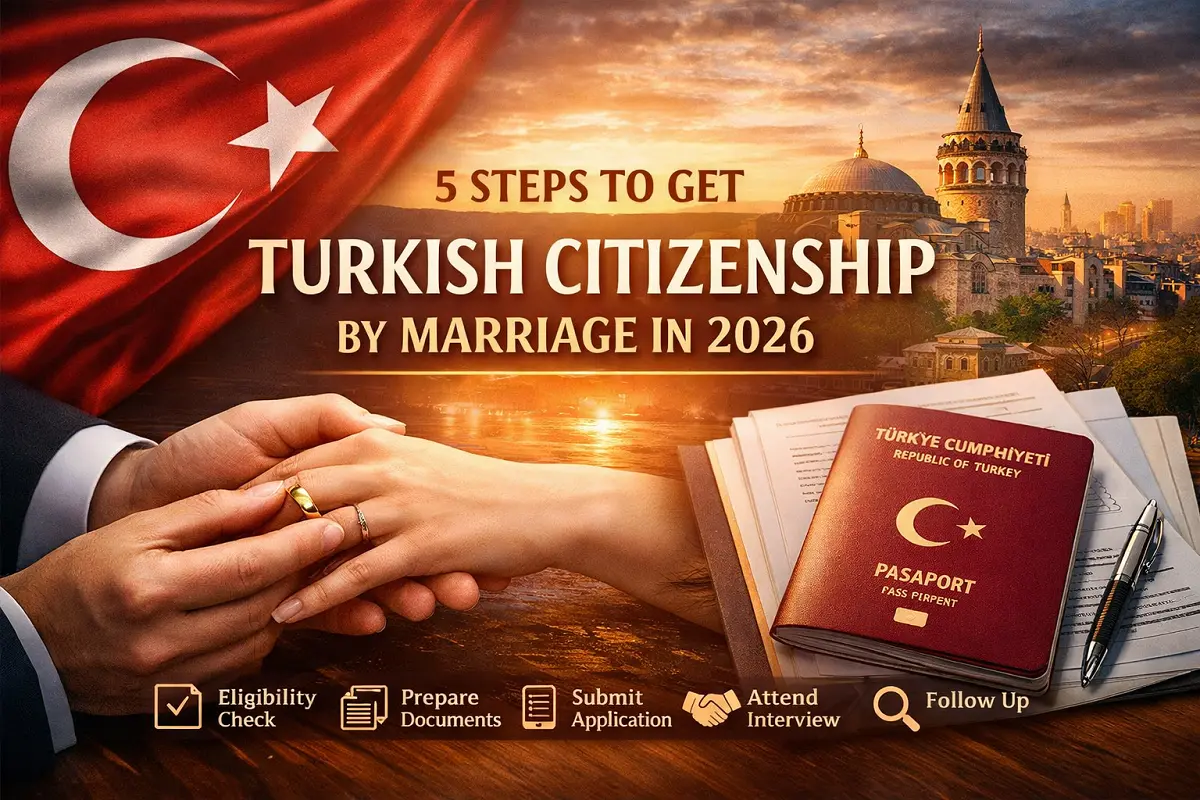
Turkish citizenship by marriage can be obtained in 2026 through a clear five-step legal process:
- evaluating eligibility,
- preparing the required documents,
- submitting the application,
- attending the citizenship interview, and
- carefully following the file until a final decision is issued.
Turkish citizenship by marriage is regulated under Law No. 5901, Article 16. To qualify, a foreign spouse must:
- Be married to a Turkish citizen for at least three years,
- Live together in a genuine marital union,
- Avoid activities incompatible with marriage, and
- Pose no threat to national security or public order.
Citizenship is not automatic and is granted only after administrative investigation and interview. Because eligibility rules, required evidence, and interview practice differ significantly by route, working with an experienced Turkish citizenship lawyer from the outset can materially reduce the risk of delay or rejection.
Citizenship by marriage is a special acquisition route regulated under Turkish citizenship law for foreigners who have established a genuine marital union with a Turkish citizen. However, being married alone is not enough. Many applicants mistakenly believe that if they are married to a Turkish citizen, they are granted citizenship automatically. In reality, citizenship by marriage is granted only after a detailed administrative evaluation that focuses on the authenticity of the marriage, family unity, and compliance with legal conditions.
By following this step-by-step approach, foreign spouses can approach Turkish citizenship by marriage in 2026 with clarity, confidence, and realistic expectations.
Step 1: Evaluating Eligibility for Turkish Citizenship by Marriage
The first step is determining whether the applicant actually meets the legal eligibility criteria set by Turkish citizenship law. Many applications are rejected at an early stage because this evaluation is either overlooked or misunderstood. Before taking any formal action, the foreign spouse must clearly understand the legal framework governing this acquisition route.
1.1 Who Can Apply for Turkish Citizenship by Marriage?
Under Turkish citizenship law, a foreign national who is legally married to a Turkish citizen may apply for Turkish citizenship by marriage, provided that the marriage is officially recognized and ongoing. The applicant must be in a valid civil marriage with a Turkish citizen. Religious-only marriages or unregistered unions do not create eligibility.
1.2 Marriage Duration Requirement Under Turkish Law
One of the core requirements for the marital citizenship process is the minimum marriage duration. As of 2026, the foreign spouse must have been married to a Turkish citizen for at least three years before submitting the application. This period is calculated from the official marriage registration date, not from the date of cohabitation or engagement. Applications submitted before completing this period will be rejected regardless of other factors, making timing a crucial element.
1.3 Genuine Marriage and Family Unity Assessment
Turkish authorities place strong emphasis on whether the marriage is genuine and whether family unity exists. During the evaluation, officials assess if the couple lives together, shares a real family life, and maintains an ongoing marital relationship. This assessment plays a central role in the application, as sham or formal marriages aimed solely at citizenship are strictly excluded from protection.
1.4 Situations That May Prevent Citizenship by Marriage
Certain situations may block or delay the application, even if the marriage duration requirement is met. These include ongoing separation, evidence of a fictitious marriage, threats to public order or national security, or inconsistent statements during the evaluation process. Understanding these risks early helps applicants approach the process realistically and ensures a stronger position when they eventually apply for Turkish citizenship by marriage.
Step 2: Preparing the Required Documents for Turkish Citizenship by Marriage
After confirming eligibility, the second step is the careful preparation of all required documents. This stage is far more important than many applicants realize, as even minor inconsistencies or missing paperwork can significantly delay the process or lead to rejection.
2.1 Mandatory Documents for the Applicant
The foreign spouse must submit a complete and accurate set of personal documents. These typically include a valid passport, birth certificate, marital status certificate, residence permit, biometric photographs, and a fully completed citizenship application form. These documents allow authorities to verify identity, legal status, and compliance with the requirements for Turkish citizenship by marriage.
In addition to the general documentation requirements outlined above, the official application guidelines published by the Directorate General of Civil Registration and Citizenship Affairs provide a more detailed list of mandatory documents for citizenship by marriage applications. According to the official authority, applicants are required to submit a complete set of supporting documents to verify their identity, marital status, and eligibility. The official document issued by the Directorate can be accessed here.
The required documents include:
- Application Form (VAT-6)
- Two biometric photographs (50×60 mm, white background, ICAO-compliant, machine-readable format)
- Passport or equivalent document indicating the applicant’s nationality; for stateless persons, a duly certified document with notarized Turkish translation
- A notarized Turkish translation of an official document containing full identity details required for registration
- A valid residence permit if the applicant resides in Turkey
- A certified copy of any final court decision related to criminal records, if applicable
- If the applicant’s date of birth does not include day and month, an officially issued document from the competent authority of the country of origin (notarized Turkish translation required), or a signed declaration accepting 1 July as the default date in accordance with Article 39 of the Population Services Law No. 5490
- Receipt proving payment of the application fee deposited to the Ministry of Finance treasury
It should be noted that the list of required documents may vary depending on the specific circumstances of the application, the practice of the competent population directorate, and updates in the applicable legislation. Therefore, it is strongly recommended to seek assistance from a qualified Turkish citizenship lawyer in Turkey to ensure the application is prepared correctly and in full compliance with current legal requirements.
2.2 Documents Required from the Turkish Citizen Spouse
The Turkish citizen spouse must also provide specific documents to support the application. These generally include a Turkish identity card, population registration record (nüfus kayıt örneği), marriage registration document. These records confirm the spouse’s Turkish nationality and the legal existence of the marriage. Without these documents, it is not possible to apply for Turkish citizenship by marriage, even if the foreign spouse’s file is otherwise complete.
2.3 Foreign Documents, Apostille, and Certified Translation
One of the most sensitive aspects of this route involves foreign-issued documents. Documents obtained abroad must usually be apostilled or legalized in accordance with international conventions. After legalization, they must be translated into Turkish by a sworn translator and notarized in Turkey. Failure to comply with apostille and certified translation rules is one of the most common reasons applications are delayed or returned.
2.4 Common Documentation Mistakes to Avoid
Applicants often assume that being married to a Turkish citizen gets them a citizenship automatically and underestimate document scrutiny. Expired passports, inconsistent personal information, missing apostilles, or unofficial translations can all jeopardize Turkish citizenship by marriage applications. Paying close attention to document accuracy at this stage significantly increases the likelihood of a smooth and successful application process.
Step 3: Applying for Turkish Citizenship by Marriage
Once eligibility is confirmed and all documents are properly prepared, the third step in this route is the formal submission of the application. This stage transforms preparation into an official legal process and is often where applicants begin to interact directly with Turkish administrative authorities.
3.1 Where to Apply for Turkish Citizenship by Marriage
The place of application depends on the applicant’s residence. The application is submitted to the Provincial Directorate of Population and Citizenship (Nüfus ve Vatandaşlık İşleri). Choosing the correct authority is essential, as applications submitted to the wrong institution cannot be processed. Regardless of location, the same requirements for the application apply, and the application is ultimately evaluated by central authorities in Turkey.
3.2 How to Apply for Turkish Citizenship by Marriage Step by Step
The applicant must first schedule an appointment through the official appointment system of the Turkish Directorate General of Population and Citizenship Affairs. On the appointment date, officials review the documents for formal completeness and register the application in the system.
After submission, the file enters the administrative evaluation process, during which background checks are conducted and the authenticity of the marriage is examined. This step demonstrates clearly that being married to a Turkish citizen can get you a citizenship only after a structured legal review, not automatically. Applicants seeking to acquire citizenship by marriage must therefore be prepared for an ongoing assessment rather than an instant result.
Step 4: Attending the Citizenship Interview (Marriage Interview)
One of the most decisive stages of the application is the citizenship interview, often referred to as the marriage interview. Even when all documents are complete and the application is properly submitted, the interview can significantly influence whether the applicant will successfully acquire Turkish citizenship by marriage.
4.1 Purpose of the Citizenship Interview
The primary purpose of the interview in the application is to assess the authenticity and continuity of the marital relationship. Authorities aim to confirm that the marriage is genuine, ongoing, and not entered into solely for the purpose of citizenship. During this evaluation, officials also consider whether the couple maintains family unity and whether the foreign spouse poses any risk to public order or national security. This reinforces the principle that being married to a Turkish citizen gets you citizenship only after a thorough legal and factual assessment, not automatically.
4.2 Common Interview Questions for Married Couples
Interview questions are designed to test the consistency of the couple’s shared life. Questions often cover how and where the couple met, daily routines, household arrangements, family members, important dates, and future plans. In some cases, spouses may be interviewed together or separately. Inconsistent or contradictory answers can raise doubts about the marriage’s authenticity, even if all requirements for Turkish citizenship by marriage appear to be met on paper.
4.3 How to Prepare for the Marriage Interview
Proper preparation is key to approaching the interview with confidence. Applicants should review their application file carefully and ensure that all information provided is accurate and consistent. There is no need to memorize answers; however, both spouses should be familiar with basic details of their shared life. Transparency and calm communication are far more effective than rehearsed responses.
Understanding that the interview is a standard part of the process helps reduce anxiety. Applicants who have correctly followed the steps to apply for Turkish citizenship by marriage and who are in a genuine marital relationship generally have no reason to fear this stage. When approached honestly and consistently, the interview becomes a confirmation rather than an obstacle in the process.

Step 5: File Tracking and Decision Process After Application
The final stage begins once the application file has been officially submitted and the citizenship interview has been completed. At this point, many applicants mistakenly assume that no further action is required.
5.1 How Long Does Turkish Citizenship by Marriage Take in 2026?
In 2026, the processing time for citizenship by marriage varies depending on the completeness of the file, the applicant’s background, and the workload of the authorities. On average, the evaluation process may take a year to several years. This timeframe includes security checks, verification of marriage authenticity, and administrative review by relevant institutions. Meeting all requirements does not guarantee a fast decision, but it significantly reduces the risk of delays caused by additional document requests or repeated evaluations.
5.2 Monitoring the Application Status
Applicants can monitor the status of their application through official channels.
Depending on where the application was submitted, updates may be obtained from the relevant Provincial Directorate of Population and Citizenship.
In addition, applicants can check the status of their citizenship application through the e-Devlet (Turkish e-Government) portal using the official Citizenship Application Inquiry service.
While detailed explanations are not always provided during the evaluation stage, regularly monitoring the application helps applicants respond promptly if additional information or documents are requested.
Keeping track of the file throughout the process can help prevent unnecessary delays and ensure that the application proceeds as smoothly as possible.
5.3 Possible Outcomes: Approval or Rejection
There are two possible outcomes.
Approval means the applicant has successfully met all legal and factual criteria and is granted Turkish citizenship by a formal decision.
Rejection occurs when authorities conclude that the legal conditions are not met, such as insufficient proof of a genuine marriage or concerns related to public order.
These outcomes highlight an important reality: being married to a Turkish citizen gets you a citizenship only when the full process is completed positively.

Conclusion: The Correct Legal Path to Acquire Turkish Citizenship by Marriage
Turkish citizenship by marriage in 2026 is not a single action but a structured legal journey that requires patience, accuracy, and a clear understanding of the law.
Throughout this article, the five-step process has been explained in detail to provide a realistic roadmap for foreign spouses who want to secure their legal status in Turkey through marriage. When approached correctly, Citizenship by marriage remains a reliable and lawful way to build a permanent future in Turkey.
The process begins with evaluating eligibility, which ensures that the applicant genuinely meets the legal foundation.
This is followed by the careful preparation of documents, a stage where accuracy directly impacts the success of the application.
The third step, submitting the application, marks the official start of the administrative process and demonstrates that those who are married to a Turkish citizen get citizenship only after formal legal scrutiny.
The interview stage then confirms the authenticity of the marriage, while the final step involves patient file tracking and awaiting a lawful decision.
For those who wish to acquire citizenship by marriage, the key takeaway is clarity and compliance.
Each step builds upon the previous one, and skipping or underestimating any stage weakens the entire application. In 2026,
Turkish authorities continue to apply a predictable but strict evaluation approach, rewarding genuine marriages supported by proper documentation and transparent conduct.
Ultimately, Turkish citizenship by marriage is not about speed or shortcuts; it is about following the correct legal path.
Applicants who respect this structure, understand their obligations, and approach the process realistically place themselves in the strongest possible position to achieve a positive outcome and fully enjoy the rights and stability that Turkish citizenship provides.