
The file we will examine as a Fraud Charges Turkey case study begins much like many of our criminal defense cases: with a distressed and anxious client contacting us for urgent legal assistance.
Our client, a foreign national residing in Turkey under a residence permit, reached out to us after receiving an electronic notification from the Public Prosecutor’s Office. Upon reviewing the notification, we discovered that, following an ongoing criminal investigation, the prosecutor had summoned our client to provide a statement as a suspect.
Recognizing the seriousness of the situation, we immediately advised the client to issue a Power of Attorney in our favor. Once the PoA was completed, we attended the relevant Prosecutor’s Office and conducted a thorough review of the investigation file.
Our examination revealed a surprising set of facts. A third party, completely unknown to our client, had fallen victim to a fraud scheme and subsequently filed a criminal complaint.
During the investigation, the prosecutor traced the movement of the allegedly fraudulent funds and determined that our client’s bank account appeared within the transfer chain of the disputed money.
At this stage, despite having no direct connection to either the alleged fraudsters or the underlying transaction, our client had become involved in the investigation due to the financial trail identified by the authorities.
This is precisely the point at which a carefully structured fraud defense strategy in Turkey must be developed, with the objective of demonstrating the client’s lack of criminal intent, explaining the origin and purpose of the transactions, and preventing an innocent individual from being wrongfully implicated in a fraud prosecution.
Background: A Foreign Crypto Trader Living in Turkey
Our client is a foreign investor residing in Turkey. As an expatriate involved in cryptocurrency trading in Turkey, he first arrived in the country several years ago and has since maintained his lawful status through valid residence permits.
He is an ordinary individual with no criminal history and no connection to any unlawful activities. The client supports himself through income generated from investments held abroad and is not engaged in any employment or commercial activity in Turkey.
In addition to his investment income, he personally participates in cryptocurrency trading. Like many retail traders, he buys and sells USDT and other cryptocurrencies against fiat currencies such as USD and TRY, earning modest profits from price differences and market fluctuations.
The vast majority of individuals with whom he trades are unknown to him. This is entirely normal within the cryptocurrency trading ecosystem. Similar to other traders, he locates counterparties through cryptocurrency trading platforms and engages solely in the relevant transactions.
Apart from the trade itself, he has no personal relationship, communication, or business connection with these individuals and possesses no further information regarding their identities, backgrounds, or activities.
Accordingly, our client’s involvement in cryptocurrency transactions is limited to ordinary trading activities conducted through widely used platforms.
He does not investigate the personal circumstances of each counterparty, nor would such an expectation be realistic in a market where thousands of transactions are conducted daily between participants who have no prior relationship with one another.
His activities are therefore consistent with those of a typical cryptocurrency trader seeking to profit from legitimate market opportunities rather than from any unlawful scheme or fraudulent enterprise.
How the Fraud Actually Happened
The Original Scam (Unrelated to Our Client)
In reality, the underlying fraud had absolutely no connection to our client.
The complainant in this case became the victim of an online fraud scheme. The incident occurred when the complainant came across an advertisement for computer on a website and clicked on the relevant listing. Using the contact information provided on the website, the complainant contacted the purported seller and expressed an interest in purchasing the advertised parts.
After negotiating the price, the parties reached an agreement, and the seller instructed the complainant to transfer the purchase amount to a designated bank account. Once the payment was made, however, the seller disappeared and ceased all communication. It later became apparent that the individual was not a legitimate seller at all, but rather a fraudster operating a classic online marketplace scam.
Upon realizing that he had been deceived, the complainant filed a criminal complaint with the Public Prosecutor’s Office. During the complaint process, he provided the authorities with the telephone number used during the transaction as well as the bank account details to which he had transferred the funds. These details formed the starting point of the subsequent criminal investigation.
Where the Stolen Funds Went Next
Once the funds reached the fraudsters’ control, the next phase of the scheme began. At this stage, the primary objective of the perpetrators was not merely to obtain the money but to conceal its origin and ultimately transfer it to accounts that could not easily be linked back to them.
For this reason, the initial recipient account is often not owned by the fraudsters themselves. Experienced fraudsters understand that receiving the victim’s payment directly into their personal bank accounts would allow law enforcement authorities to identify them relatively quickly. Instead, they commonly use third-party accounts belonging to other individuals.
In Turkey, one frequently encountered method involves recruiting university students or financially vulnerable individuals to open multiple bank accounts in their own names. In exchange for a monthly fee, these individuals allow others to use their accounts, often without fully understanding the criminal purpose behind the arrangement. As a result, the fraudsters gain access to seemingly legitimate bank accounts while distancing themselves from the initial transaction.
After receiving the funds, the perpetrators typically move the money through multiple transfers in an effort to obscure the financial trail. In some cases, they instruct the account holder to withdraw the funds in cash and hand over the proceeds. In other cases, they rapidly transfer the money through a series of intermediary accounts before ultimately taking possession of it.
With the rise and widespread adoption of cryptocurrencies, however, fraudsters have increasingly adopted a third method. Because cryptocurrency transactions can create additional layers of complexity for investigators, criminals often attempt to convert fraud proceeds into cryptocurrency before moving those assets through various wallets and exchanges. Their objective is to make tracing the ultimate destination of the funds significantly more difficult than in a traditional banking environment.
This is precisely where our client’s unfortunate involvement begins. Our client was not connected to the original fraud, did not know the victim, and had no relationship whatsoever with the perpetrators.
Instead, as an ordinary cryptocurrency trader conducting routine market transactions, he unknowingly became one of the participants in a transaction chain that the fraudsters used in their attempt to move and disguise the proceeds of their crime.
As a result, when investigators followed the movement of the stolen funds, our client’s account appeared within the broader transfer chain, despite the fact that he had no knowledge of the underlying fraud and had engaged only in what he believed to be a legitimate cryptocurrency trade.
How Prosecutors Traced the Money to Our Client
Following the initiation of the criminal investigation, the Public Prosecutor’s Office began an asset tracing process in an effort to identify the individuals responsible for the fraud.
In fraud investigations of this nature in Turkey, prosecutors typically start by requesting information from the bank that received the victim’s payment. The bank is asked to provide account records, transaction histories, and details regarding where the funds were subsequently transferred.
Once the destination account is identified, the prosecutor sends a similar request to the next bank, and then to the next one, continuing the process until the flow of funds can no longer be traced through the traditional banking system.
The information collected from the various financial institutions is then analyzed by the relevant law enforcement unit and compiled into an investigative report, which is submitted to the Prosecutor’s Office for evaluation.
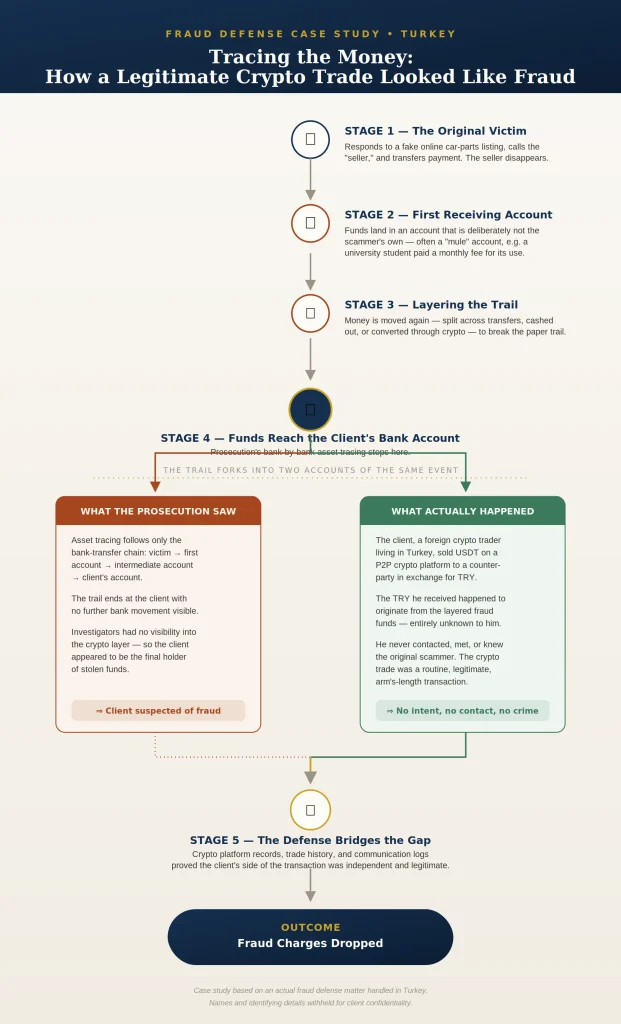
The same process was followed in our case. The authorities conducted a detailed asset tracing investigation and determined that, on the day of the fraud, the funds were first transferred from the initial recipient account to another bank account and were subsequently transferred to our client’s account.
At that point, the financial trail appeared to end, and the asset tracing process effectively stopped.
From the perspective of the investigators, the stolen funds had entered our client’s bank account and remained there as the final identifiable destination within the traditional banking system. Naturally, this circumstance caused our client to attract the attention of the authorities and led to his inclusion in the investigation as a suspect.
However, the reality of the transaction was entirely different.
What had actually occurred was that our client, acting as an ordinary cryptocurrency trader, had entered into a transaction through a cryptocurrency trading platform. Pursuant to that agreement, he sold USDT to another trader and received Turkish Lira (TRY) in exchange.
In other words, the incoming bank transfer represented payment for cryptocurrency that our client had legitimately sold through a routine peer-to-peer (P2P) trading transaction.
The crucial issue is that the prosecutors were only able to follow the movement of funds through bank accounts. The asset tracing process did not reveal what happened after the money reached our client’s account because the corresponding cryptocurrency transfer occurred outside the traditional banking system.
As a result, investigators could see that the funds arrived in our client’s bank account, but they could not immediately see that the money had been exchanged for USDT and transferred to another party through a cryptocurrency platform.
Consequently, at the initial stage of the investigation, the authorities were unaware that our client had merely acted as a cryptocurrency seller in an ordinary commercial transaction.
The banking records alone created the appearance that the funds had stopped with him, when in reality he had already delivered cryptocurrency to the counterparty in exchange for the payment received.
This distinction ultimately became one of the most important aspects of our defense strategy, as it demonstrated that our client was not a participant in the fraud scheme but rather an unwitting intermediary whose account appeared in the transaction chain solely because of a legitimate cryptocurrency trade.
What Our Client Was Accused Of
Ultimately, our client was falsely accused of fraud in Turkey.
He was summoned by the Public Prosecutor’s Office to provide a statement as a suspect within the scope of the investigation.
In this context, our client was effectively being accused of being a fraudster. Moreover, as a result of the investigation, his bank accounts had been frozen by the prosecutor’s office. Consequently, he was unable to use his bank accounts and could not carry out his day-to-day financial transactions.
Building the Defense
Of course, once we learned the contents of the investigation file, the most important issue became developing the correct defense strategy.
At this stage, after thoroughly reviewing the file and obtaining a comprehensive understanding of the allegations, our first step was to meet with our client and explain the details of the case.
Once our client became fully informed about the investigation, he provided us with a detailed account of what had actually occurred.
Within this framework, we developed and implemented the most appropriate fraud defense strategy in Turkey for his specific circumstances.
Establishing No Contact With the Perpetrator
The first and most important issue was to demonstrate that our client had absolutely no connection or relationship with the perpetrator and did not even know the individual.
At this stage, we explained to the prosecutor how trading operates on the relevant cryptocurrency platform and demonstrated that our client had encountered this individual for the first time through the transaction conducted on the platform, and that his interaction with the person was limited solely to that trade.
We substantiated these facts with the evidence available to us.
Reconstructing the Trade Timeline
At this stage, using both the information we obtained from the investigation file and the information available to us, we prepared a visual presentation for submission to the Prosecutor’s Office explaining the case from our perspective.
In this presentation, we illustrated how the trading timeline unfolded, explained the mechanics of cryptocurrency trading, and set out the transactions that occurred on the relevant day.
We also mapped the likely flow of funds, beginning with the fraudsters’ initial transfer, continuing through our client’s transaction, and demonstrating how the funds may have progressed thereafter.
In addition to the documentary evidence, we submitted this visualized explanation to the Prosecutor’s Office in order to make our client’s situation as clear and understandable as possible and to assist the authorities in accurately evaluating the circumstances of the case.
Evidence We Gathered to Prove Legitimate Trading Activity
We then began gathering evidence to prove our client’s innocence and demonstrate that he had merely engaged in a legitimate cryptocurrency trade.
In this regard, we collected extensive documentation from the relevant cryptocurrency platform, including transaction receipts, records confirming that the transfer had been completed, user profile information relating to the transaction, and the communications exchanged on the day of the trade.
All of these materials were carefully compiled and submitted by our office to the Prosecutor’s Office as part of the investigation file.
Demonstrating Lack of Knowledge
In addition to the steps described above, we relied on one of the most important legal defense mechanisms available in this case: demonstrating lack of knowledge.
Under the Turkish Penal Code, criminal offenses can generally only be committed intentionally unless the law expressly provides otherwise. The offense of fraud is likewise a crime that can only be committed with intent.
In our client’s case, the question was straightforward: how could he have had any intention to participate in the fraudulent scheme when he did not even know the individuals who carried out the fraud, let alone have any involvement in their actions?
Accordingly, relying on the evidence we had collected and the overall circumstances of the case, we demonstrated that our client had no knowledge whatsoever of the fraudulent activity.
We showed that he was unaware of the origin of the funds, had no relationship with the perpetrators, and had participated only in what he believed to be a legitimate cryptocurrency transaction.
Through these submissions, we sought to ensure that the Prosecutor’s Office fully understood that our client lacked the knowledge and intent required for criminal liability in relation to the alleged fraud.

The Legal Strategy Under Turkish Law
Under Article 157 of the Turkish Penal Code, the offense of fraud is regulated, while Article 158 sets forth the aggravated forms of this offense.
According to the statutory definition, fraud consists of deceiving a person through fraudulent conduct and thereby obtaining a benefit for oneself or another person to the detriment of the victim or a third party.
Accordingly, in order to be considered a perpetrator of fraud, a person must have committed the act described in the legal definition of the offense; namely, deceiving another person through fraudulent conduct and obtaining a benefit for himself, herself, or another person at the expense of the victim or a third party.
As explained above, it is clear that our client did not engage in any such conduct. He did not communicate with the victim, did not make any misrepresentations, did not participate in the fraudulent scheme, and did not obtain any benefit through deceptive means.
As an alternative theory of criminal liability, one might consider aiding and abetting the commission of the offense. However, such liability likewise requires that the individual possess an active intention to assist in the commission of the crime.
As we have demonstrated throughout this case, our client had absolutely no knowledge of the underlying fraud and did not know any of the individuals involved in the incident.
Taking these facts into consideration, any attempt to characterize our client as a person who aided the commission of the offense would also be contrary to law.
For these reasons, the defense we prepared on behalf of our client was structured around these legal principles and was supported by documentary evidence, transaction records, and detailed factual explanations demonstrating both the absence of fraudulent conduct and the absence of any criminal intent on the part of our client.
Precedents on Innocent Third-Party Fund Recipients
In addition, as a result of many years of practice in Turkish criminal law and the extensive legal research resources we have developed over time, we routinely identify and utilize relevant judicial precedents in support of our defenses.
Accordingly, we reviewed our database of court decisions and incorporated into our submissions those higher court rulings that were particularly relevant to the facts of this case.
One such decision was especially significant because its reasoning closely mirrored the circumstances of our client’s situation.
In its decision numbered 2021/16966 Merits and 2024/7470 Judgment, dated 04 June 2024, the 11th Criminal Chamber of the Court of Cassation (Yargıtay) held that it was unlawful to convict a defendant where there was no definite, credible, and doubt-free evidence sufficient to establish that the defendant had participated in the acts of the other defendants.
The Court found that, in the absence of such evidence, an acquittal should have been ordered instead of a conviction.
Because the principles established in this decision closely aligned with the facts of our case, we relied upon this precedent in our defense and argued that the allegations against our client should be dismissed, as there was no sufficient evidence demonstrating his knowing participation in the underlying fraudulent scheme.
The Outcome: Charges Dropped
As a result, through the defense strategy we developed, together with our comprehensive legal submissions and the careful presentation of evidence using tailored explanatory and visual techniques, we were able to clearly demonstrate our client’s lack of involvement in the alleged fraud.
Following our submissions and the evaluation of the evidence presented, the allegations directed against our client were dismissed by the Public Prosecutor’s Office, and no criminal liability was attributed to him in connection with the investigation.
Prosecutorial Decision
After our client’s statement was taken, and following the submission of our petitions, legal defenses, and detailed explanations to the investigation file, as well as the meetings we held with the prosecutor, we were able to expedite the process.
As a result, the Public Prosecutor’s Office issued a Decision of Non-Prosecution (Kovuşturmaya Yer Olmadığına Dair Karar) in favor of our client.
This means that the allegations directed against our client were dismissed and that no criminal prosecution or criminal trial would be initiated against him.
Below, we share an anonymized version of the prosecutor’s decision, with all identifying information removed in order to protect our client’s confidentiality. 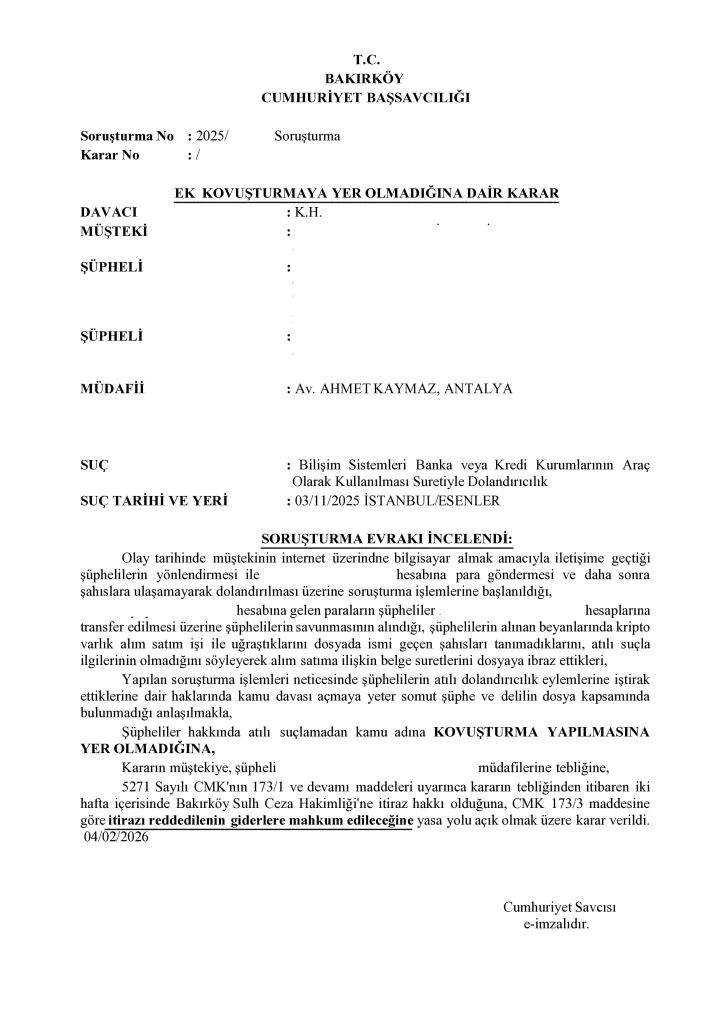
What This Meant for Our Client
This outcome had two significant consequences for our client.
First, his innocence was established.
Second, his bank accounts became fully accessible once again.
Establishing our client’s innocence at such an early stage spared him from having to endure the lengthy, stressful, and burdensome process of a criminal trial. It also protected him from the potential penalties that could have resulted from a criminal prosecution, including imprisonment and monetary fines.
Moreover, because our client is a foreign national residing in Turkey, the favorable outcome also protected him from potential immigration-related consequences that could have arisen following a criminal conviction and its enforcement, such as deportation proceedings or an entry ban into Turkey.
The second important consequence concerned the restrictions imposed on his bank accounts.
Following the issuance of the Decision of Non-Prosecution, we immediately applied to the Prosecutor’s Office and requested that official notifications be sent to the relevant banks instructing them to remove the freezes placed on our client’s accounts.
As a result of these efforts, the restrictions on our client’s bank accounts were lifted. Consequently, he regained access to his funds, was once again able to conduct his day-to-day financial activities, and recovered his financial freedom.
What Foreign Crypto Traders in Turkey Should Learn From This Case
In conclusion, one of the most important points to consider is the identity of the person with whom you are trading.
Unfortunately, within today’s Turkish criminal justice system, it is not uncommon for individuals to face allegations of this nature.
This is largely because, when prosecutors conduct an asset tracing investigation, they generally have no immediate way of knowing that a cryptocurrency trade took place behind a particular bank transfer.
As a result, a person whose bank account appears in the transaction chain may initially attract suspicion despite having no involvement in the underlying fraud.
For this reason, it is extremely important, whenever possible, to avoid conducting cryptocurrency trades with unknown or unverified individuals.
Taking precautions regarding the counterparties with whom you transact can significantly reduce the risk of becoming involved in criminal investigations arising from fraudulent activities committed by third parties and can help prevent the inconvenience, stress, and financial restrictions that such allegations may cause.
When to Seek Legal Counsel
If you learn that you are under criminal investigation, you should consult a criminal defense lawyer immediately.
Early legal assistance is crucial because an effective defense strategy can be developed before any significant procedural steps are taken, allowing the necessary defense mechanisms to be implemented as quickly as possible.
Prompt legal intervention may help ensure that the facts and evidence supporting your position are presented to the authorities at the earliest stage of the investigation.
As demonstrated in the case discussed above, a well-prepared defense can, in appropriate circumstances, result in the allegations being dismissed before any criminal prosecution is initiated.
Failing to obtain legal representation at an early stage may significantly increase the likelihood of becoming involved in a lengthy, stressful, and burdensome criminal proceeding that could otherwise have been avoided.
How We Can Help
As Kaymaz Law Firm, we draw upon years of extensive experience in criminal law to prepare the strongest possible defenses for our clients.
We carefully analyze each case, develop tailored legal strategies, and work diligently to protect our clients’ rights and interests at every stage of the process.
Our goal is to achieve the best possible outcome for our clients in the most efficient manner, combining thorough legal analysis, strategic advocacy, and proactive case management to address challenges before they escalate into more serious legal consequences.
Our Approach to Fraud Defense Cases in Turkey
In reality, every case is unique and must be examined on its own facts.
Effective legal representation requires the development of a tailored defense strategy based on the specific circumstances of each individual case.
For clients accused of fraud, our first step is to conduct a thorough review of the investigation file before any significant legal proceedings take place.
We carefully analyze the evidence, assess the strengths and weaknesses of the case, identify potential procedural errors, and evaluate any deficiencies in the prosecution’s evidence.
Thereafter, we meet with our client to explain the contents of the file in detail, obtain a comprehensive understanding of the events from the client’s perspective, and identify any facts or evidence that may be relevant to the defense.
Based on this detailed analysis, we develop the most appropriate defense strategy for the particular circumstances of the case and take the necessary legal steps to protect our client’s rights and interests throughout the investigation and any subsequent proceedings.