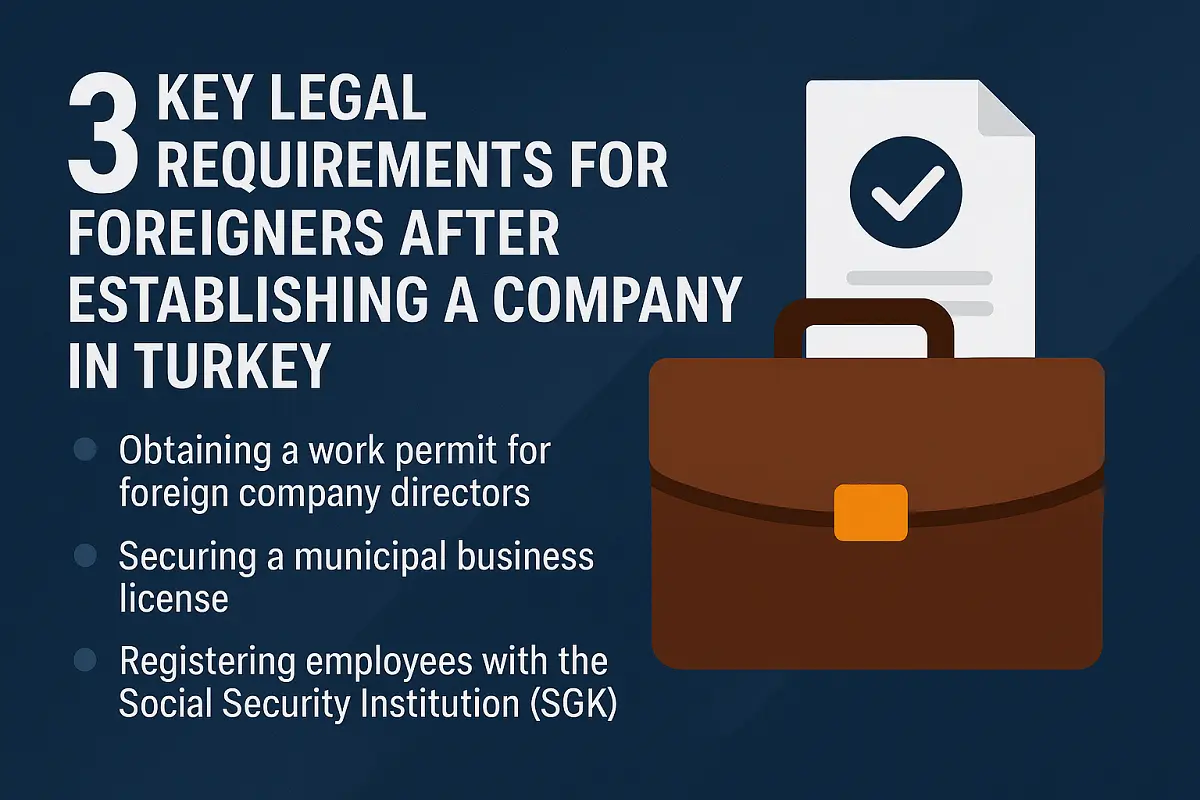
The three key legal requirements for foreigners after establishing a company in Turkey are: obtaining a work permit for foreign company directors, securing a municipal business license, and registering employees with the Social Security Institution (SGK).
Establishing a company in Turkey is an exciting step for many foreign entrepreneurs who wish to tap into the country’s dynamic market and strategic location. However, forming the company itself is only the beginning of the legal journey. Many new foreign business owners mistakenly assume that once registration is complete, operations can begin immediately without further obligations. In reality, post-establishment compliance is just as important as the company formation process.
Foreign investors must be aware that Turkey enforces strict rules regarding company management, workplace operations, and employee registration. Ignoring these obligations can lead to serious consequences such as administrative fines, the inability to legally operate, and in extreme cases, the closure or sealing of the business premises.
This article highlights the three most critical legal requirements foreigners must complete after registering a company in Turkey. By understanding the necessity of a work permit for foreign directors, the requirement of obtaining a municipal business license, and the obligation of registering employees with SGK, foreign entrepreneurs can ensure their business remains compliant, protected, and positioned for long-term success.
Table of Contents
I. Requirement 1: Obtaining a Work Permit for Foreign Company Directors
Foreigners who are appointed as company directors in Turkey must obtain a valid work permit before they can legally manage and represent the business. This is one of the most important legal requirements after establishing a company, and failure to comply can create immediate barriers to running operations.
What the Law Says
Under Turkish legislation, foreign nationals cannot serve as active directors or managers of a company unless they are authorized to work in the country. The Ministry of Labor and Social Security is the competent authority for granting work permits. The application process typically requires:
- Proof of the company’s registration and trade registry records.
- The director’s passport and residence information.
- Financial documentation showing the company’s capital and planned activities.
Once approved, the work permit allows the foreign director to carry out managerial duties, sign binding documents, and represent the company in dealings with authorities.
Why It Matters for Foreign Directors
Many foreign investors believe that simply registering their company automatically grants them the right to act as its director. In practice, however, the absence of a work permit can lead to a legal deadlock: the person formally appointed in the trade registry cannot complete mandatory registrations. This situation can stall the company’s activities before they even begin.
Consequences of Non-Compliance
Operating without a work permit exposes both the individual and the company to significant risks:
- Administrative Fines: Authorities may impose financial penalties on the company and the unauthorized director.
- Barriers to Other Compliance Steps: Without a recognized work permit, municipalities often refuse to issue a business license, creating a chain reaction of non-compliance.
Strategic Importance for Business Success
Obtaining a work permit should not be seen as a bureaucratic hurdle but rather as an investment in the company’s legal security. It establishes the director’s authority beyond question and allows the business to build trust with clients, banks, and state institutions. In competitive markets like Turkey, this credibility is critical.
Key Takeaway
For foreign entrepreneurs in Turkey, the work permit is the cornerstone of post-establishment compliance. Without it, other legal requirements such as securing a municipal business license or registering employees with the Social Security Institution may become impossible to complete. Ensuring this step is done quickly after company formation helps safeguard smooth operations and prevents costly disruptions.
II. Requirement 2: Securing a Municipal Business License
Every company in Turkey that operates from a physical workplace must obtain a municipal business license before starting commercial activities. This license is issued by the local municipality and is a legal prerequisite for opening offices, shops, factories, or any other type of business premises.
Purpose of the License
The municipal business license serves as official confirmation that a workplace meets legal, technical, and safety standards. Authorities use this process to ensure that businesses operate in suitable locations, comply with zoning rules, and provide safe environments for employees and customers. For foreigners, obtaining this license is particularly important because it is the document that transforms a registered company into a legally recognized operating business.
Application Process
The process of obtaining the license varies slightly depending on the municipality but generally requires:
- A copy of the company’s trade registry certificate and tax registration.
- The lease contract or proof of ownership of the premises.
- Approval documents related to building use and zoning compliance.
- Fire safety and health inspection approvals where applicable.
- Work permit of the foreign company director.
Municipalities may request additional documents depending on the nature of the business. For example, restaurants, bars, or manufacturing facilities often face stricter requirements due to public health and safety concerns.
Risks of Operating Without It
Foreign entrepreneurs sometimes overlook this step, assuming that company registration alone is sufficient to start business operations. However, operating without a municipal business license carries serious consequences:
- Immediate Closure: Authorities have the power to seal workplaces that do not hold the license.
- Administrative Fines: Companies can face financial penalties for unauthorized operation.
- Barrier to Growth: Without the license, banks, clients, and other institutions may refuse to cooperate with the business, damaging credibility.
How It Connects to Other Requirements
One of the biggest challenges foreigners face is the interdependence of compliance steps. For example, if the company director is a foreign national, municipalities generally require proof of a valid work permit before granting a business license. This means that failure to obtain the work permit first can block the business license application, delaying operations indefinitely.
Strategic Value for Business Success
Far from being a mere formality, the municipal license adds legitimacy and stability to the business. It shows that the company operates transparently, within the law, and in safe conditions. For foreign-owned businesses, this credibility is essential to winning trust in the Turkish market.
Key Takeaway
Securing a municipal business license is not optional—it is the legal foundation for operating any physical business in Turkey. Foreign entrepreneurs should prioritize this step immediately after company formation to avoid closures, penalties, and unnecessary delays. By doing so, they ensure that their investment is protected and their business can operate confidently in compliance with Turkish law.

III. Requirement 3: Registering Employees with the Social Security Institution (SGK)
After establishing a company in Turkey, all employers must register their employees with the Social Security Institution (Sosyal Güvenlik Kurumu – SGK) before they begin work. This obligation applies to both local and foreign employees and is one of the cornerstones of labor law compliance in Turkey.
Legal Obligation
Under Turkish labor and social security law, every employee must be insured, and their information must be reported to SGK electronically. Employers are responsible for submitting the employee’s details—such as identity, position, and start date—no later than one day before the employee actually begins work. This ensures that workers are covered under Turkey’s social security system from the very first day of employment.
Why It Matters
For foreign business owners, this requirement goes far beyond administrative paperwork. Registering employees with SGK guarantees that workers have access to:
- Health insurance coverage.
- Pension and retirement rights.
- Workplace injury and occupational disease protection.
- Other statutory benefits under Turkish law.
Failure to register employees not only deprives workers of these protections but also exposes the employer to significant risks.
Consequences of Non-Compliance
The penalties for failing to comply with SGK obligations can be severe and have long-term consequences for the company’s reputation and financial stability. Risks include:
- Heavy Fines: Employers face substantial administrative penalties for each unregistered employee.
- Back Payments: SGK can demand retroactive premium payments, often with interest.
- Loss of Credibility: Businesses that ignore social security rules may struggle to attract qualified employees, as word quickly spreads in the local labor market.
- Legal Liability: In case of workplace accidents involving unregistered employees, the employer can be held fully responsible for medical costs and compensation.
How It Connects to Foreign Companies
Foreign-owned companies are not exempt from SGK obligations. Even if the owner or director is a foreign national, once the company employs staff in Turkey, registration with SGK becomes mandatory. Moreover, for companies seeking work permits for foreign staff, proof of SGK registration and proper payroll practices is often required by the Ministry of Labor as part of the evaluation process.
Strategic Value for Sustainable Growth
Complying with SGK rules is not only about avoiding penalties; it is also a way to build trust and stability. Companies that prioritize their employees’ legal rights tend to have lower turnover rates, stronger reputations, and better relationships with government authorities. For foreign entrepreneurs, this can be a major advantage when competing in the Turkish market.
Key Takeaway
Registering employees with SGK is a fundamental step in turning a registered company into a legally compliant and sustainable business in Turkey. By fulfilling this obligation, foreign business owners protect their workforce, avoid costly sanctions, and demonstrate commitment to fair and lawful operations.
IV. Why Post-Establishment Legal Compliance Matters
Starting a company in Turkey is a significant milestone for foreign investors, but registering the company is only the first step. The real challenge begins after establishment, when business owners must comply with ongoing legal requirements that ensure the company can operate smoothly and lawfully. Ignoring these post-establishment obligations can quickly turn a promising investment into a costly and frustrating experience.
The most important reason compliance matters is that legal recognition of your business depends on more than just company registration. For example, if a foreign national is appointed as the company director, Turkish law requires them to hold a valid work permit. Without it, business may face restrictions in carrying out official transactions.
Another crucial factor is the municipal business license. Many foreign entrepreneurs underestimate this requirement and assume that once the company is registered with the trade registry, they can immediately begin operations. In reality, without a municipal license, the workplace is considered unauthorized. This exposes the company to administrative penalties, including the possibility of the workplace being sealed by local authorities.
Finally, compliance with social security obligations is essential. Registering employees with the Social Security Institution (SGK) is not just a bureaucratic formality—it is a legal duty. Failing to fulfill it can result in heavy fines, loss of employee protections, and reputational damage that harms both the company and its ability to attract qualified staff.
In short, legal compliance after company establishment is what transforms a registered entity into a functioning and protected business in Turkey. Foreign investors who neglect these obligations risk financial losses, operational delays, and in some cases, the complete suspension of their business activities.

V. Real Case Example: When Ignoring Compliance Shut Down a Business
To better understand the importance of post-establishment compliance, let’s look at a real case involving one of our foreign clients who opened a limited liability company in Turkey. At first, everything seemed to go smoothly. The company was registered with the trade registry, the tax number was obtained, and a commercial lease was signed for the workplace. The client, a foreign national, was also appointed as the sole company director.
However, a critical mistake was made: the director never applied for a work permit. Since the company’s management authority was held by a foreigner, Turkish law required that person to secure a valid work permit from the Ministry of Labor.
This oversight had a direct effect on the next compliance step—obtaining a municipal business license. When the company applied for its workplace license, the municipality asked for the director’s valid work permit as part of the application file. Because this document was missing, the municipality rejected the application. Despite this, the client decided to begin operations, assuming that the issue could be resolved later.
Within weeks, local inspectors visited the workplace and discovered that the company was operating without a municipal business license. As a result, the premises were officially sealed, and the business was forced to close its doors. The company not only lost valuable time and income but also suffered reputational damage in the local market.
This case demonstrates how ignoring one compliance requirement can trigger a chain reaction. Without the work permit, the business license could not be issued; without the business license, the company could not legally operate. The lesson is clear: post-establishment compliance steps are interconnected, and overlooking even one can bring an entire business to a halt.

VI. Conclusion
Foreigners who establish a company in Turkey must comply with three essential post-establishment legal requirements: obtaining a work permit for company directors, securing a municipal business license, and registering employees with the Social Security Institution (SGK). Neglecting any of these obligations can lead to fines, operational delays, and even the complete closure of the business, as illustrated by real cases of companies being sealed due to non-compliance.
Each of these requirements plays a critical role in ensuring that a company can operate legally, securely, and efficiently. The work permit validates the director’s authority and enables the company to perform official transactions. The municipal business license ensures that the workplace complies with safety, zoning, and technical standards. SGK registration protects employees’ rights while safeguarding the business from administrative sanctions and legal liability.
For foreign entrepreneurs, understanding and following these obligations is not just about avoiding penalties—it is about establishing credibility, protecting investments, and creating a stable foundation for long-term success in Turkey’s dynamic market. The legal compliance process may seem complex, but each step is manageable with the right guidance and expert support.
At Kaymaz Law Firm, we specialize in assisting foreign investors in Turkey to navigate these post-establishment legal requirements efficiently and confidently. From obtaining work permits for company directors to securing municipal licenses and completing SGK registrations, we ensure your business operates fully within the law.
Don’t risk delays, fines, or business closure. Contact Kaymaz Law Firm today to secure your company’s legal compliance and safeguard your investment in Turkey. We provide personalized, professional guidance so your business can focus on growth, not legal obstacles.